
An Electronic Health Record (EHR) is an electronic version of a patient’s medical history that the provider maintains over time. It may include all the critical administrative and clinical data relevant to that person’s care under a particular provider, including demographics, progress notes, problems, medications, vital signs, past medical history, immunizations, laboratory data, and radiology reports. The EHR automates access to information and has the potential to streamline the clinician’s workflow. The EHR also can support other care-related activities directly or indirectly through various interfaces, including evidence-based decision support, quality management, and outcomes reporting.
EHRs are the next step in the continued progress of healthcare that can strengthen the relationship between patients and clinicians. The data, and the timeliness and availability of it, will enable providers to make better decisions and provide better care.
Ezovion HMS provides five types of EHR: General EHR, Obstetrics EHR, Pediatrics EHR, Dental EHR, and Gynecology EHR.
The EHR consists of the following:
- Health Record Dashboard
- Case Sheet
- Treatment Plan
- Lab Reports
- Radiology
- Attachments
- Bills
- Growth Chart (Available for Pediatric patients only)
- Health Record Dashboard:
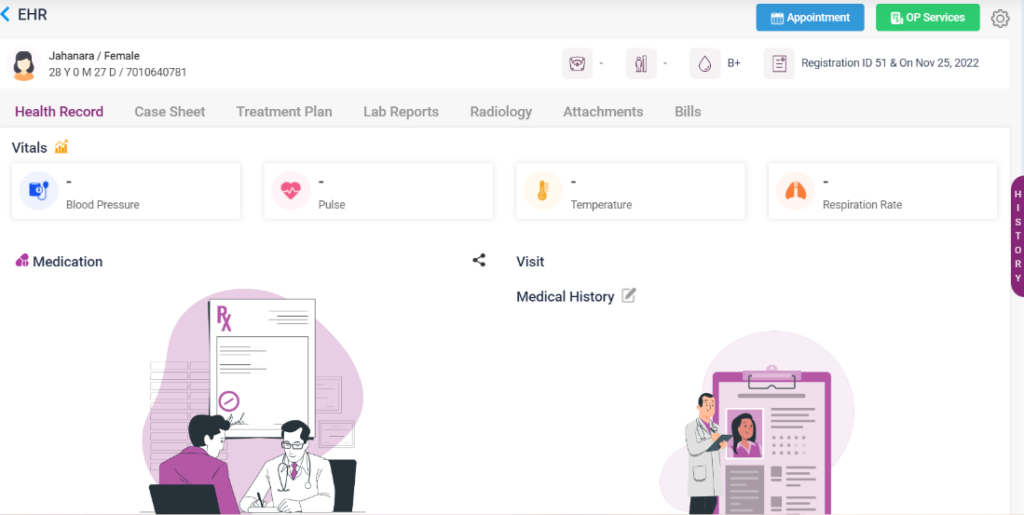
The Health Record Dashboard systematically contains the following details.
- Vitals– Recent vitals, including BP, pulse, temperature, and respiration rate of the patient, were taken recently.
- Medication- Details of the medicines taken by the patient with medicine count and several days.
- Visit- Visit the history of the patient.
- Advice- Advice provided by the patient, if any.
- Obstetrics- If it is an Obstetrics EHR, then the obstetrics details of the patient will be displayed.
3.2.4. – Health Record dashboard
- Case Sheet:
A Case Report is a detailed report of a patient’s symptoms, signs, diagnosis, treatment, and follow-up.
It is a formal communication between health care professionals, such as doctors and nurses, regarding a patient’s clinical information.
Open a new case sheet by clicking on the doctor’s name under the case sheet tab. The user can open the old case sheets of the patient also.
New Case Sheet:
The new case sheet contains the following details to be entered by the user,
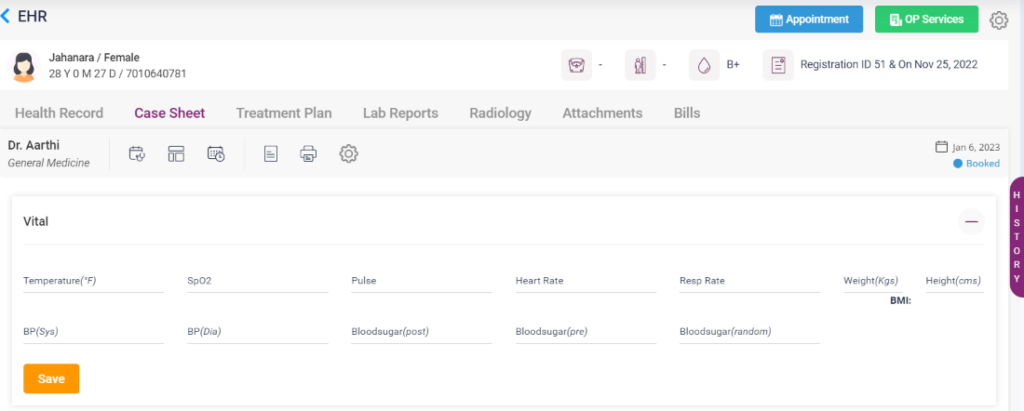
1. Vitals- The vitals section includes, Temperature, BP (systolic and diastolic), pulse, Respiration rate, heart rate, blood sugar(pre, post, and random), SPO2, Weight, and height. After entering these data, the user can click the “Save” button.
3.2.5- EHR Case Sheet- Vitals
2. Chief Complaints- In this section, select the patient’s chief complaint from the drop-down list and select the period. Enter the present history and notes if needed. Click on the “Add” button on the right, and the chief complaint entered will be saved and displayed on the top. Click on the added chief complaint to edit or delete it.
3.2.6. – EHR Case Sheet- Chief Complaints

3. Examination- The user can select the examination from the drop-down list. Enter the period, severity, and notes if needed. Click on the “Add” button to display the examination added. Click on the added examination to edit or delete it.
3.2.7. – EHR Case Sheet- Examination

4. Investigation- Select the investigation from the service drop-down box in this section. Enter the test results and notes if needed. Click on the “Add” button to display the investigation added. Click on the added investigation to edit or delete it.
3.2.8. – EHR Case Sheet- Investigation
5. Diagnosis- The user can select the diagnosis from the diagnosis name drop-down list and select the high-risk check box if the diagnosis is critical. Enter the treatment given in the field if needed. Click on the “Add” button to display the diagnosis added. Click on the added diagnosis to edit or delete it.
3.2.9. EHR Case Sheet- Diagnosis
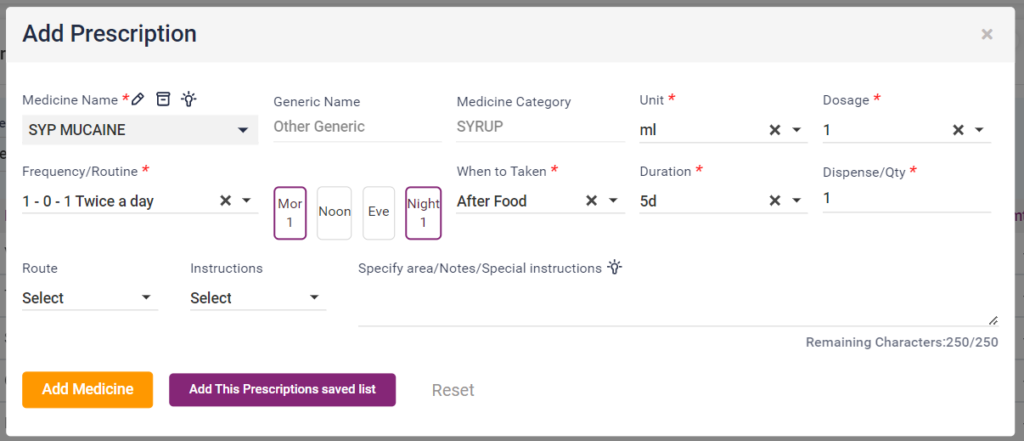
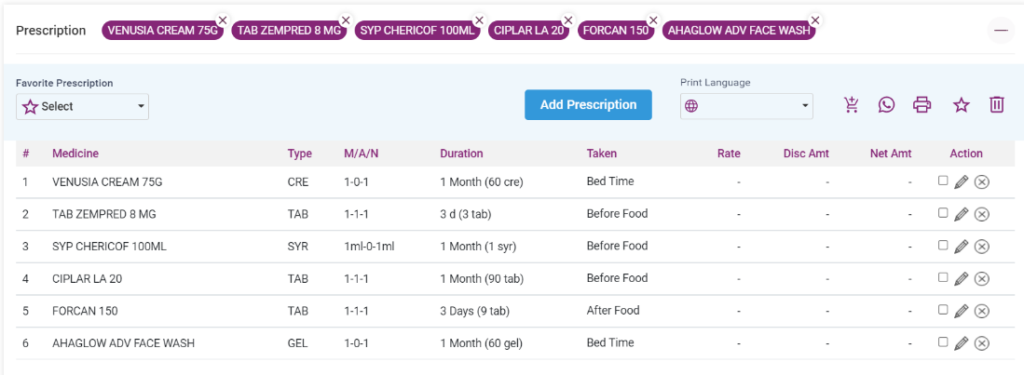
6. Prescription-
- Favorite Medicine: On clicking the drop-down list, it shows the added favorite medicines.
- Medicine Name: Select the medicine name from the drop-down list.
- Category and generic Name: This field gets automatically loaded from the medicine.
- Dosage level: Select the dosage level from the drop-down list.
- Unit: Select the unit from the drop-down list.
- Tablet Routine: Select the tablet routine “Mor,” “Noon,” “Eve,” and “Night” according to the doctor’s prescription.
- Advanced Settings: Click on advanced settings to select the tablet routine hourly.
- When to take: Select “B/F,” “A/F,” “Empty Stomach,” and “Bed Time” according to the doctor’s prescription.
- Frequency: Select the prescribed frequency.
- Advice: Enter any advice if needed or select anyone from the field.
- Quantity: Quantity gets automatically calculated and is displayed.
- Rate and Amount: It gets automatically calculated and is displayed.
- Disc Type: Select the type of discount and enter the amount or percentage accordingly.
- Net Amt: It gets calculated automatically.
- Add more Notes: On clicking Add more notes, the notes field is displayed. The user can enter notes if needed. This can be removed by clicking the “Remove more notes.”
- Add Medicine: Click the “Add Medicine” button to add the medicine to the prescription list.
- Add This Prescription Saved List: Click this button to save this particular prescription.
- Reset: Select the Reset button to delete the entered settings.
3.2.10. – EHR Case Sheet- Prescription (Add prescription)
The added medicines will be displayed in the “Added Prescription” list. The added prescription list provides the following options:
- Send to pharmacy icon: On clicking this icon, the added medicines are sent to the “Sales Dashboard” under the Pharmacy module.
- Whatsapp icon: On clicking the whatsapp icon, the prescription can be sent to the patient’s whatsapp number as a whatsapp message.
- Print icon: On clicking, the added medicines will be printed.
- Translate icon: On clicking, the entered “notes” and “when to take” fields will be translated to the selected language from the drop-down list in the “Print language” field.
- Star icon: On clicking this icon, the medicines will be added to the favorite medicine list.
- Delete icon: On clicking the delete icon, all the medicines in the list will be deleted.
- Edit icon: The edit icon can edit the medicines individually.
After this discount can be given for the overall amount by selecting the discount type and entering the amount accordingly, the final amount will be calculated and displayed in the “Total Net Amount” field.
3.2.11. – EHR Case Sheet- Prescription (Added Medicine list)
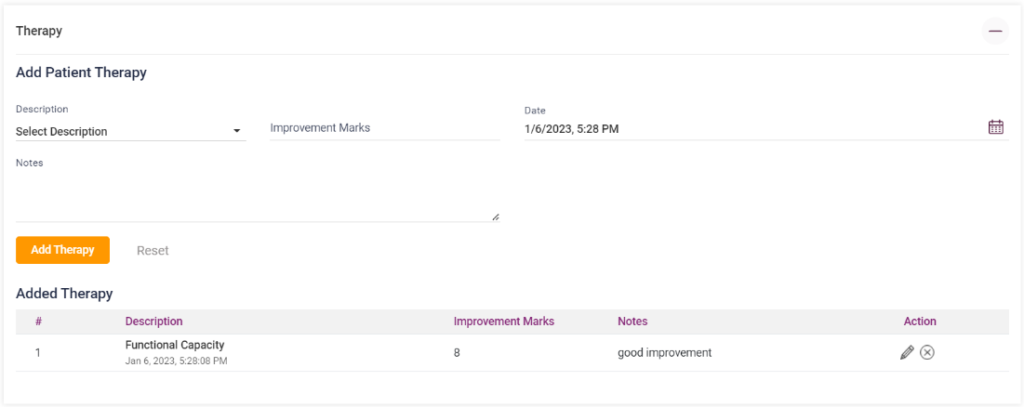
7. Therapy- The user can select the therapy from the drop-down list, enter the improvement marks and add notes, if any. The current date and time will be automatically displayed in the “Date” field. Click the “Add Therapy” button to display the therapy added to the list below. Click on the “Reset” button to delete the entered details.
Screenshot:
3.2.12. – EHR Case Sheet- Therapy
8. Instructions- Select the instruction from the drop-down list and enter notes, if any. Click on the “Add” button to display the Instructions added. Click on the added instructions to edit or delete it.
3.2.13 – EHR Case Sheet- Instructions
9. Tooth Chart-
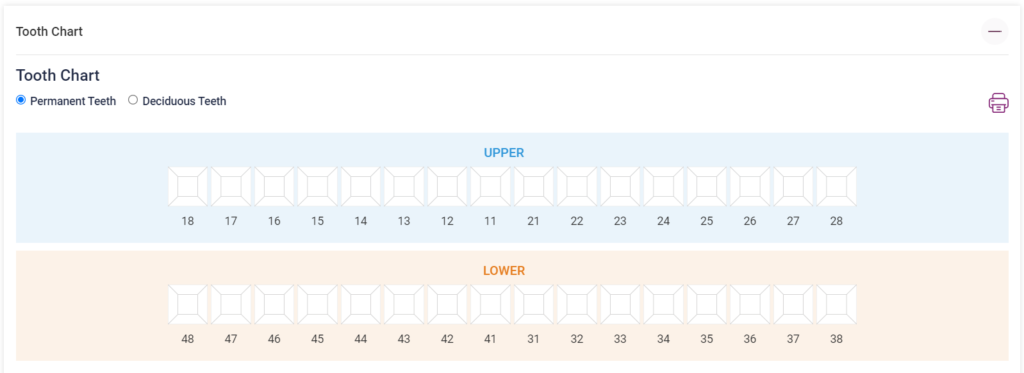
- Tooth chart: It will be available if it is a dental case sheet. The number of permanent and deciduous teeth will be displayed as an image. The user can click on each tooth, enter the tooth position details, and add color to the decayed part of the teeth according to the severity.
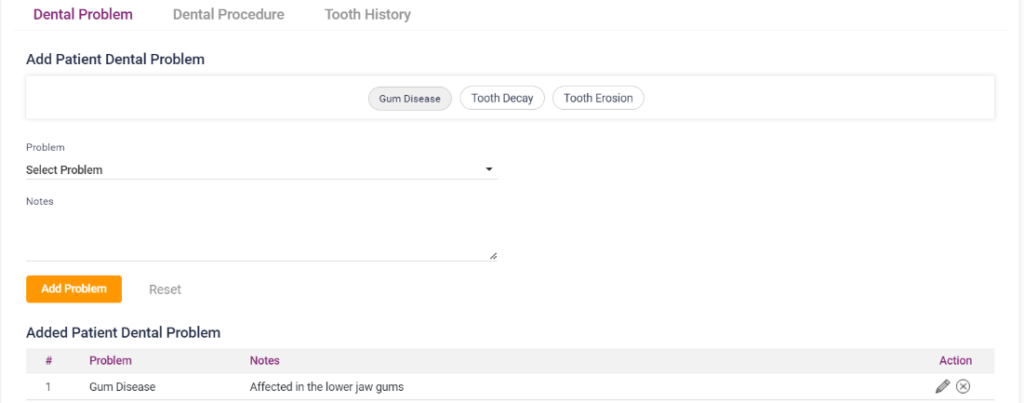
- Dental Problem: Select the dental problem from the drop-down list, and enter notes, if any. Select the “Add Problem” button to display the added dental problem in the list below. Click on the Reset button to delete the entered details. The user can edit or delete the added problems using the “Edit” and “Delete” icons.
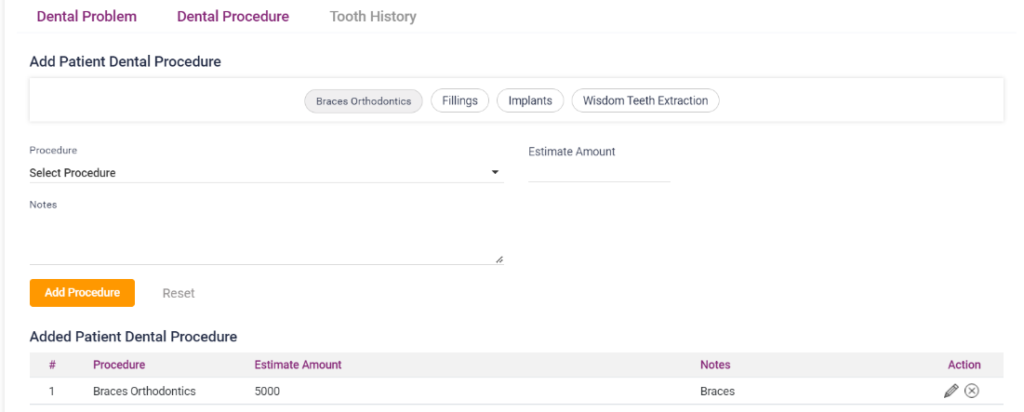
- Dental Procedure: Select the procedure from the drop-down list, and enter notes, if any. The estimated amount will be displayed automatically. Select the “Add Procedure” button to display the added dental procedure in the list below. Click on the Reset button to delete the entered details. The user can edit or delete the added procedures using the “Edit” and “Delete” icons.
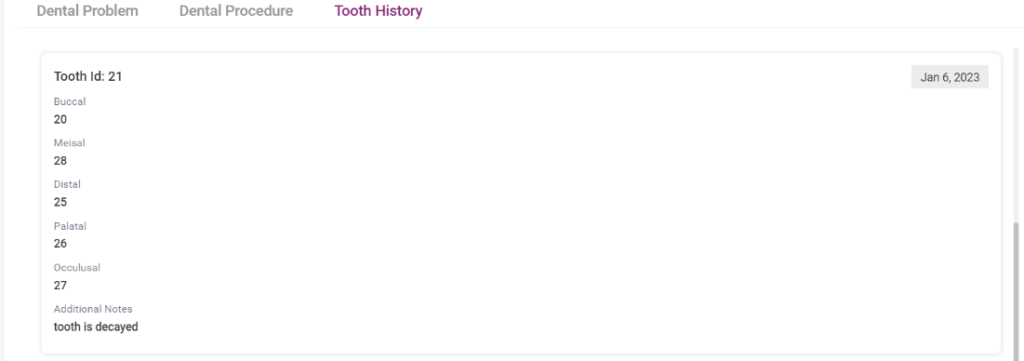
- Tooth History: This section displays the tooth details of the patient entered.
3.2.14. – EHR- Case Sheet- Tooth Chart
3.2.15. – EHR- Case Sheet-Tooth Chart- Dental Problem
3.2.16. – EHR- Case Sheet-Tooth Chart- Dental Procedure
3.2.17. – EHR- Case Sheet-Tooth Chart- Tooth History
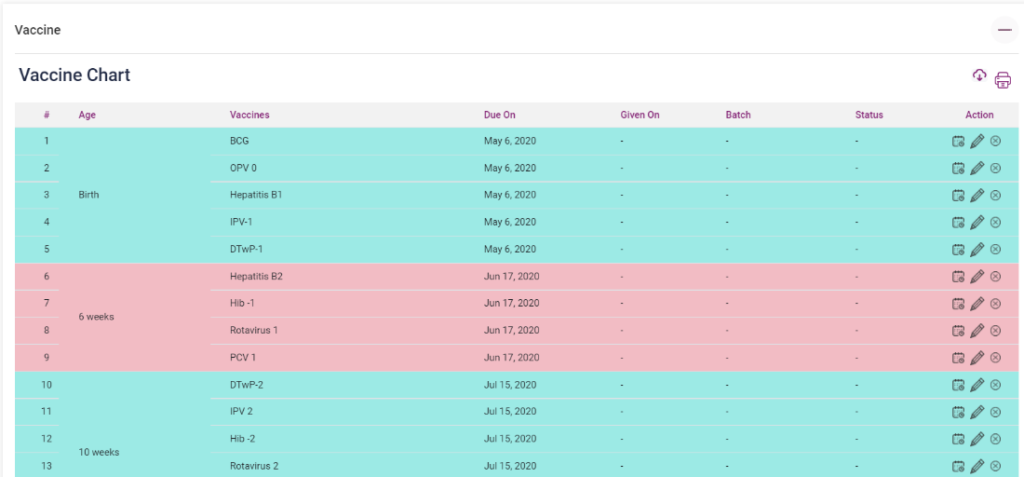
10. Vaccine Chart- This will be available only if the patient is pediatric. On opening the Vaccine chart tab, it asks to “Confirm” Once the user clicks the “Confirm” button, the vaccine chart for a child from birth to age 12 will be loaded.
3.2.18. – EHR- Case Sheet- Vaccine Chart
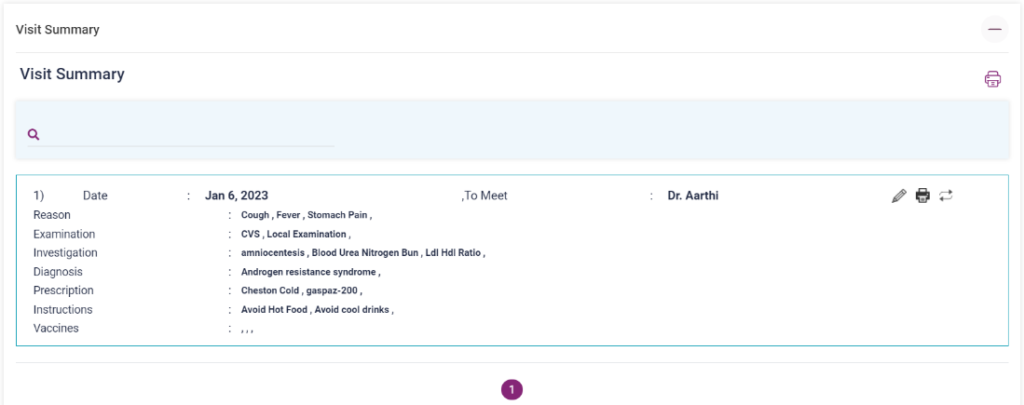
11. Visit Summary- On opening the visit summary tab, the visit history details of the patient will be loaded automatically.
Screenshot:
3.2.19. – EHR Case Sheet- Visit Summary
12. Treatment Plan- Select the patient’s treatment plan from the drop-down list, select the next visit date, and add notes, if any. Click on the “Add” button on the right, and the treatment plan entered will be saved and displayed on the top. Click on the added chief complaint to edit or delete it.
3.2.20. – EHR Case Sheet- Treatment Plan

13. Brand List- The user can add the available Combo Vaccine from the medicine list. The added vaccines will be displayed in a list below. It can be edited using the edit option.
3.2.21. – EHR Case Sheet- Brand list
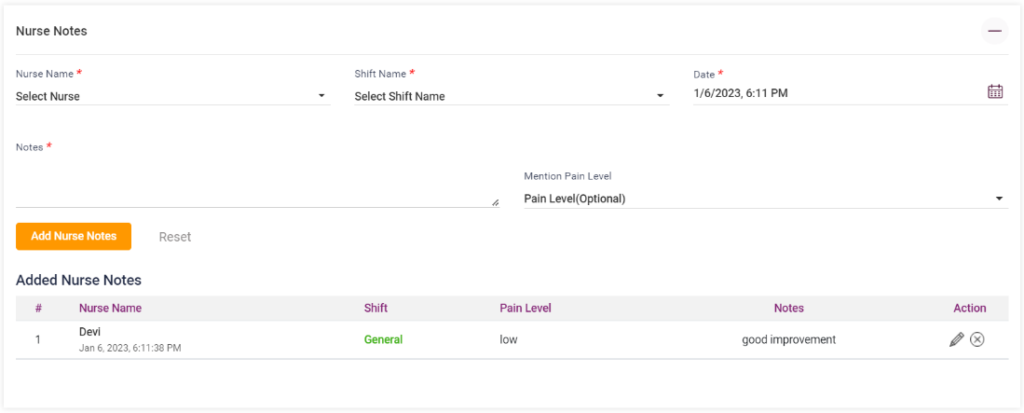
14. Nurse Notes- Select the “Nurse name,” “Shift Name,” and “Date,” enter notes, if any, and enter the “Pain level .”Click on the “Add Nurse Notes” button, the added nurse note will be saved and displayed in the list below. Click on the “Reset” button to delete the entered details. The added notes can be edited or deleted individually using the icons present.
3.2.22. -EHR Case Sheet- Nurse Notes
- Treatment Plan:
The user can add a treatment plan for the patient according to the Physician’s advice.
- Treatment Plan: Select a treatment plan from the drop-down list.
- Planned Start Date: Select a start date for the treatment plan.
- Actual Start Date: Select the actual start date of the treatment plan.
- Actual End Date: Select the actual end date of the treatment plan.
- Physician: Select the Physician who suggested the treatment plan.
- Treatment Status: Select the status of the treatment plan.
- Notes: Enter notes, if any.
- Add Treatment Plan: Select the “Add Treatment Plan” button to display the added treatment plan in the list below.
- Reset: On clicking the reset button entered details can be deleted.
- The added treatment plan can be edited individually using the edit icon in the list.
3.2.23. EHR- Treatment Plan
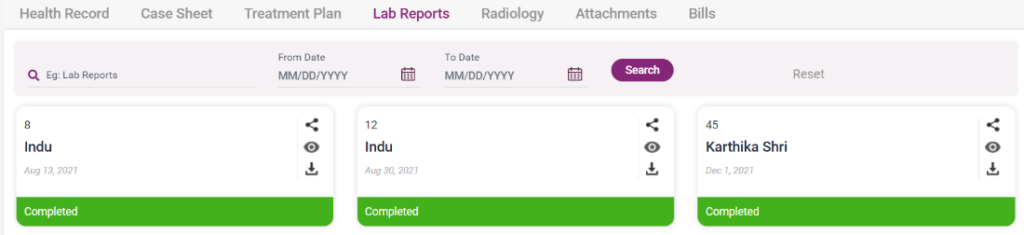
- Lab Reports:
This section contains the patient’s lab reports, which were taken and completed. The user can View, Share and Download the patient’s lab reports.
Screenshot:
3.2.24. – EHR- Lab Reports
- Radiology:
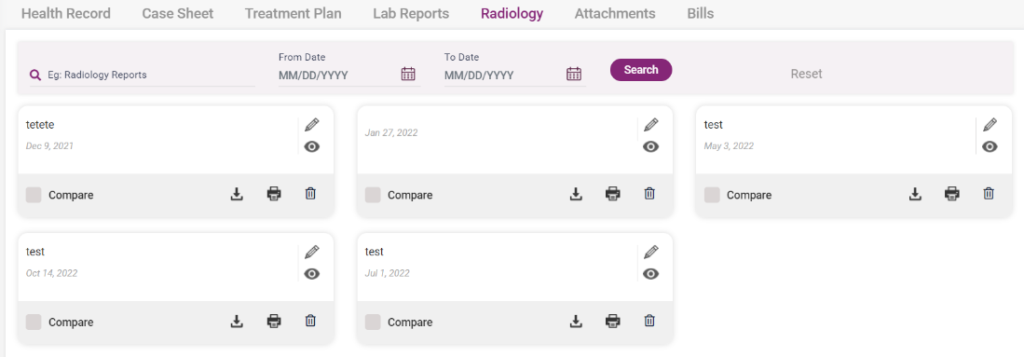
This section contains the radiology reports of the patient. The user can,
- Edit the Physician’s name and notes on the report
- Compare two reports at the same time
- Download, Print, Delete, and View the report
- You can search the reports according to the date and name
3.2.25. – EHR- Radiology
- Attachments:
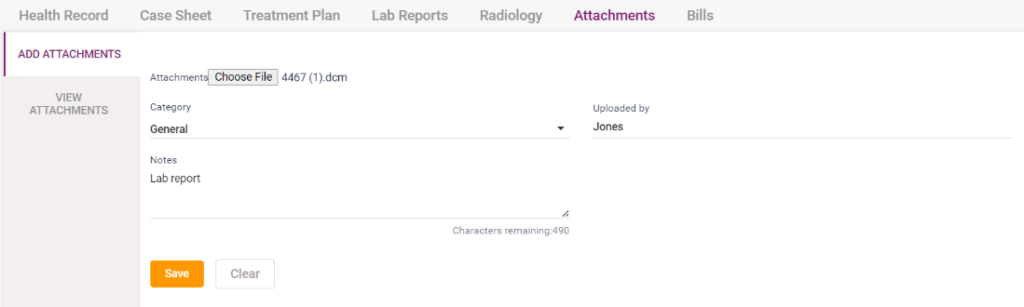
In this section, the user can attach any file which belongs to the patient. It may include lab, radiology, general consultation, prescription, or any file type.
Add attachments- The user must select the category, enter the name (who uploaded) and notes, if any, and click on the “Save” button after choosing the file from the local PC by using the “Choose File” button. The “Clear” button can be used to delete the entered details.
3.2.26. – EHR- Attachments- Add attachment
View attachments- The user can view the uploaded attachments in this section. Also, the files can be searched by date and name.
3.2.27. – EHR- Attachment- View attachment
- Bills:
This section of the EHR contains all the bills paid by the patient. The bills can be searched by date, name, and status. After searching, the bills will be displayed as a list on the page. The user can edit, print and share the bills of the patient.
3.2.28. – EHR- Bills

- Growth Chart:
The growth chart is found only for pediatric patients. It shows the growth of the child.
3.2.29. – EHR- Growth Chart